
In this project
Introduction:
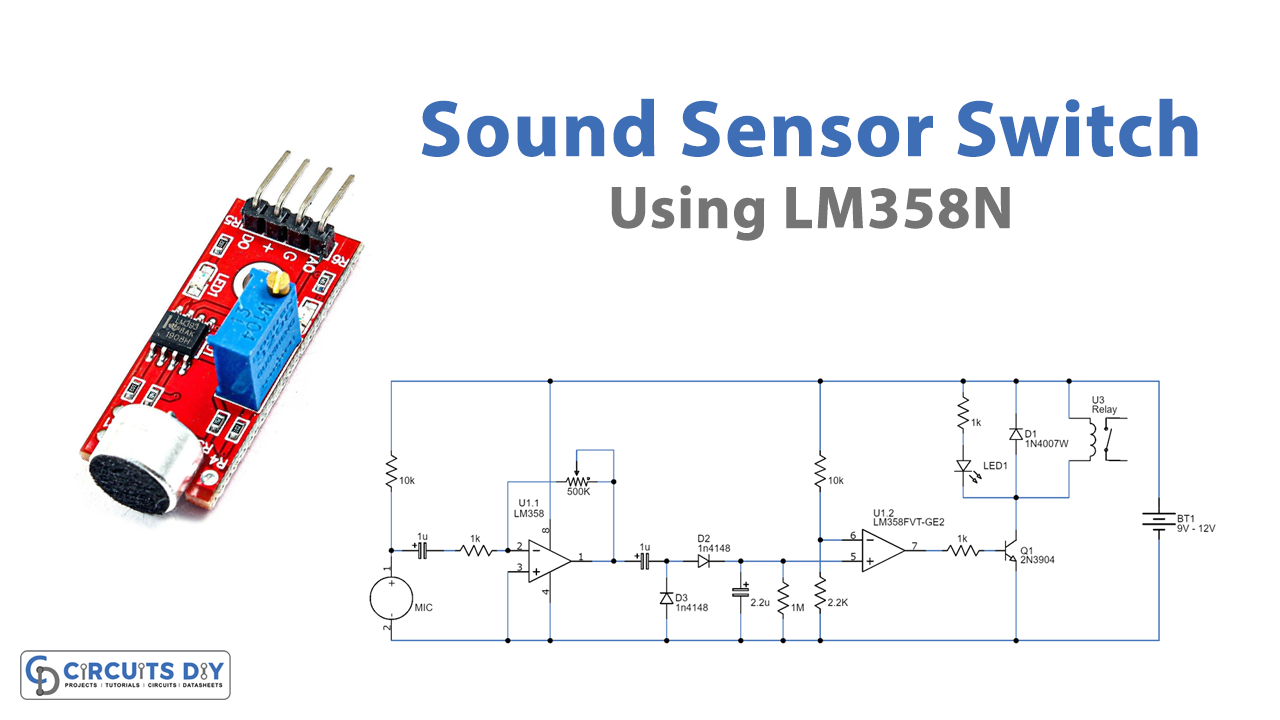
Sound sensor switch circuits can be used as a module for any system that might be assigned to trigger by detecting some kind of sound pressure level or simply applications such as a voice-activated alarm security circuit. Sound sensor switches can be used in home automation projects where a light bulb turns on responding to the sound of a knock at the door. A simple sound sensor switch can easily be made using LM358N IC.
LM358N is a dual high-gain op-amp IC, which contains two independent op-amps in one package. The circuit uses both op-amps to sense the sound. A relay is then used for switching depending on the signal received from the IC.
Hardware Required
| S.no | Component Name | Value | Qty |
| 1 | IC | LM358N | 1 |
| 2 | Resistor | 1K, 2.2K, 10K, 1M | 3, 1, 2, 1 |
| 3 | Diode | 1N4007, 1N4148 | 1 |
| 4 | LED | - | 1 |
| 5 | Battery | 9V-12V | 1 |
| 6 | NPN Transistor | 2N3904 | 1 |
| 7 | Capacitor | 2.2uF, 1uF | 1, 2 |
| 8 | MIC | - | 1 |
| 9 | Relay | 12V | 1 |
| 10 | Variable Resistor | 500K | 1 |
Pin configuration of LM358N

Circuit Diagram

Working
This simple sound switch circuit can be operated through a 9V to 12V battery. However, it can also be operated on lower voltages like 5V to 6V. LM358N IC is the key component of this project. It has two high-gain op-amps. The first op-amp, LM358A is used as an amplifier for amplifying the sound received from the microphone. The amplified sound signal at pin 1 is then passed through the 1µF decoupling capacitor and fed to the 1N4148 diodes which convert the signal into DC. The second op-amp LM358B is used as a DC amplifier which amplifies the DC signal coming from the diodes. The amplified DC signal is received at the output pin 7 of the LM358B. This amplified output then goes to the 2N3904 transistor which is used at the output to drive the relay and the LED.
Applications and Uses:
Sound sensor switches can be used in home automation projects where a light bulb turns on responding to the sound of a knock at the door. It can also be used in toys where lights turn on or off at the sound of clapping.




Discussion
Be the first to comment